Below is a conversation between Marietta, Gennaro, and Cecilia👇
All the verbs in bold throughout the text are imperative forms using tu, voi, and noi.
Gennaro: Marietta, il Natale si avvicina e io e Cecilia vogliamo fare bella figura con i nostri ospiti. Aiutaci a fare il panettone con la tua ricetta speciale, per favore.
Marietta: Volentieri. Sarà divertente! Faremo un panettone a regola d’arte!
Prima di cominciare leggete attentamente la ricetta.
Fatto? Benissimo. Ora prepariamo tutti gli ingredienti e prendiamo tutti gli utensili che ci servono. Pronti? Non perdiamo tempo! Cominciamo!
Cecilia: Si! Dicci cosa dobbiamo fare e noi eseguiamo i tuoi ordini!
Marietta: Per prima cosa prendiamo una bilancia. Dovete pesare bene tutti gli ingredienti. Cecilia, prendi il burro dal frigorifero, pesalo, poi taglialo a cubetti e fallo ammorbidire a bagnomaria.
Cecilia: Gennaro, passami il coltello, per favore!
Marietta: Gennaro, intanto prendi le uova.
Gennaro: Certo! Quante ne prendo?
Marietta: Prendine tre! Ma fa’ attenzione, non le fare cadere!
Gennaro: Sta’ tranquilla! Sono un esperto! Poi mescoliamo le uova al burro?
Marietta: Un momento, fermati! Ci servono un uovo intero e due rossi, quindi prima separa i rossi e i bianchi.
Gennaro: Eh? Un po’ difficile… Fallo tu, per favore.
Marietta: Va bene. Allora, fai un’altra cosa. Prendi la farina e lo zucchero, pesali e poi setaccia bene la farina, mi raccomando.
Cecilia: Perché?
Marietta: Evitiamo i grumi nell’impasto finale. Gennaro, ecco i due rossi! Cecilia il burro è morbido adesso? Bene. Lavoralo con una spatola. Deve diventare molto cremoso.
Cecilia: Un po’ faticoso. Così?
Marietta: Sì. Gennaro, ora metti l’uovo intero e i due rossi insieme al burro e mescola bene. Poi unisci lo zucchero e mescola ancora.
Gennaro: Quando ci fermiamo?
Marietta: Fermatevi quando avete una crema liscia e senza grumi. Cecilia, ora aggiungi la farina, un po’ alla volta, e versa anche il latte lentamente.
Cecilia: D’accordo. Posso mettere anche il lievito?
Marietta: No, non aggiungere il lievito ancora. Non ce lo mettiamo adesso, ma quasi alla fine. Aggiungi però un pizzico di sale e i canditi. Grattugia la scorza di limone, non può mancare.
Adesso impastate tutto per almeno mezz’ora. Mentre Gennaro lavora l’impasto, prepariamo lo stampo con burro e farina.
Gennaro: Dopo aver messo anche il lievito versiamo l’impasto nello stampo?
Marietta: Sì, versatelo nello stampo, ma non dimenticate l’uvetta! Che panettone sarebbe senza?
Cecilia: L’uvetta! Hai ragione, Marietta!
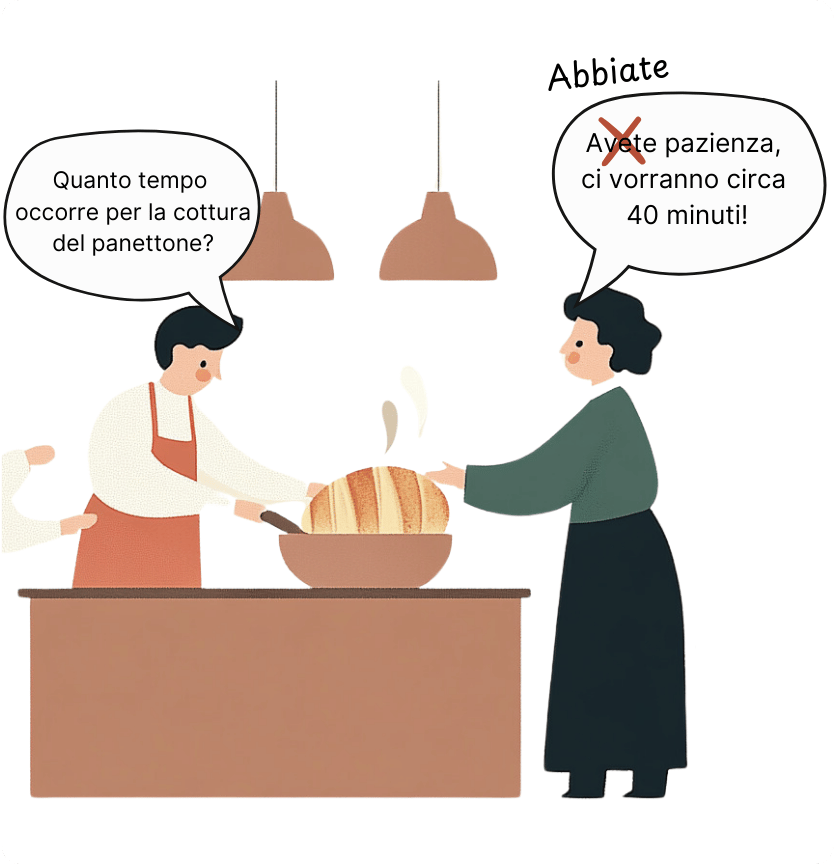
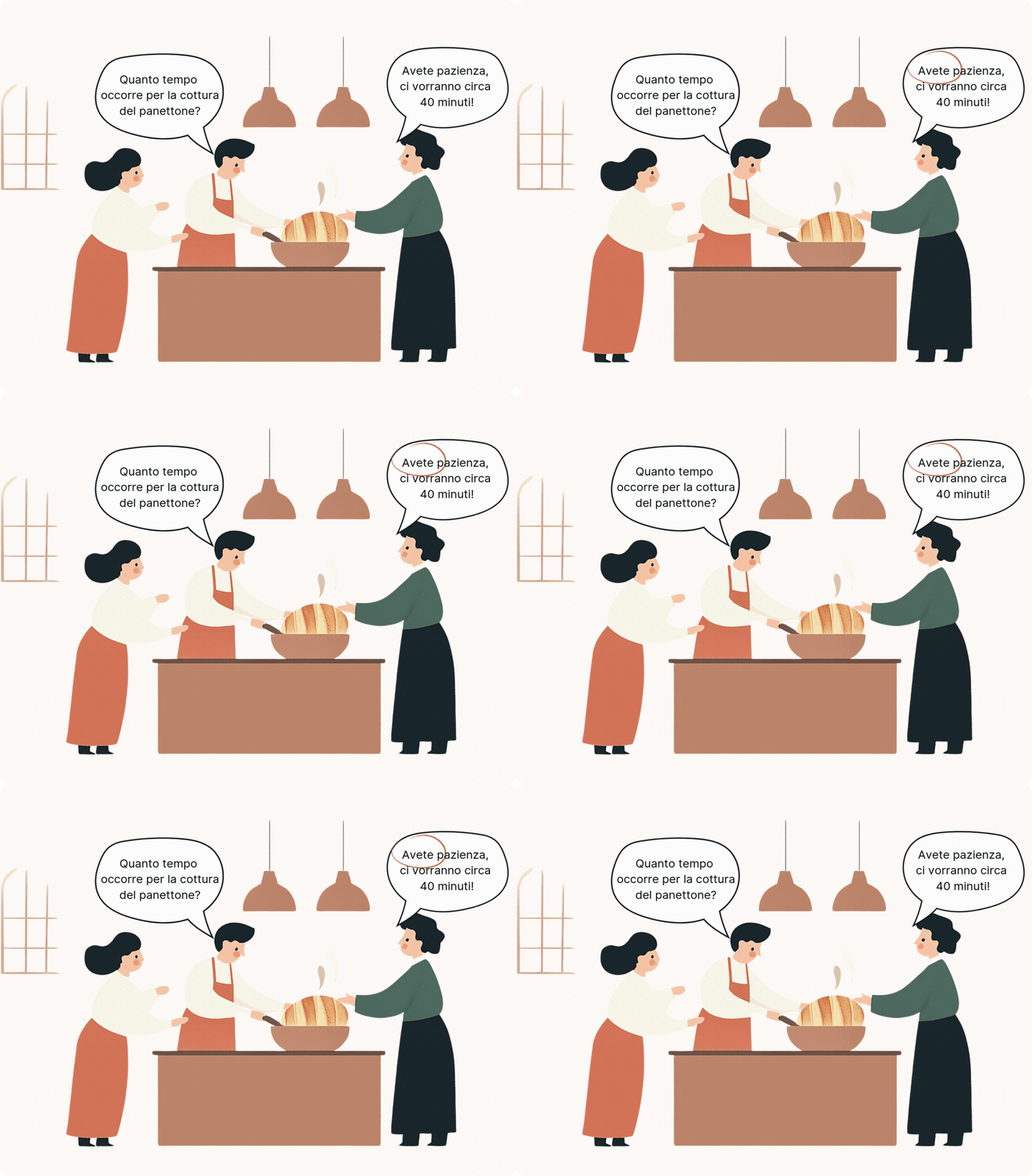
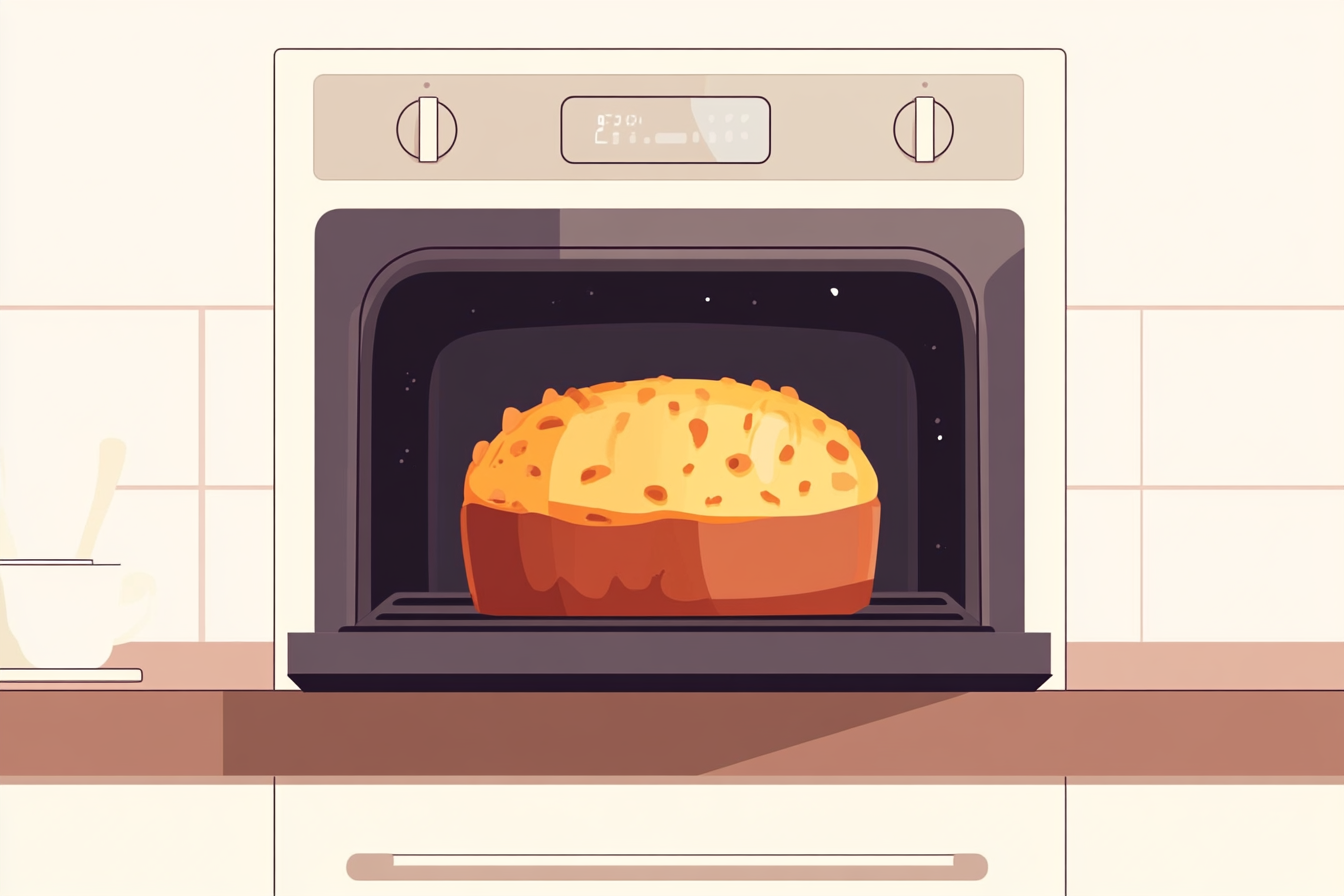
Marietta: Benissimo! Inforniamo! E abbiate pazienza, ci vorranno circa 40 minuti
40 minuti dopo…
Marietta: Questo panettone ha un aspetto perfetto. Siate orgogliosi!
The Imperative
The imperative is a verbal mood. It's used to give an order, advice, a recommendation, to invite, ask, or encourage someone to do something.
The imperative has only the present tense and two persons: the second person singular tu and the second person plural voi.
The first person singular io doesn't exist.
For the third person singular Lei, the first person plural noi, and the third person plural Loro, we use the subjunctive forms (exhortative subjunctive).
The imperative is often divided into:
• Direct or informal imperative with tu, voi, noi.
The imperative with tu and voi performs functions ranging from peremptory orders to very gentle invitations up to requests. The imperative with noi mainly performs an exhortative function, inviting to do something together.
Examples:
Prendi la farina. [Take the flour.]
Leggete la ricetta. [Read the recipe.]
Cominciamo! [Let's begin!]
• Indirect or formal imperative with Lei and Loro.
The indirect imperative is used in polite forms, particularly the imperative with Loro is very formal and used on rare occasions. In spoken language, it's often replaced with the voi imperative.
Examples:
Si accomodi, prego. [Please, have a seat.]
Prendano posto. [Please take your seats.]
With both direct and indirect imperative, we never use subject pronouns (tu, Lei, noi, voi, Loro); there is an affirmative form to order something to be done and a negative form to express a prohibition. The negative imperative with tu is formed with non + infinitive.
Examples:
Cominciamo! [Let's begin!] → Wrong: Noi cominciamo!
Setaccia la farina! [Sift the flour!]
Non dimenticate l’uvetta! [Don't forget the raisins!]
Non mangiare troppi dolci a Natale! [Don't eat too many sweets at Christmas!]

The Direct Imperative
The direct or informal imperative is used with tu, voi, and noi.
It's regular for most verbs.
• Verbs ending in -ARE like lavorare lavorare
(tu) lavora; (voi) lavorate; (noi) lavoriamo
Examples:
Preparare - (tu) → Prepara la tavola per la cena. [Set the table for dinner.]
Parlare - (voi) → Parlate più forte, non sento nulla. [Speak louder, I can't hear anything.]
Viaggiare - (noi) → Viaggiamo di più, quest’anno! [Let's travel more this year!]
• Verbs in -ERE like scrivere
(tu) scrivi; (voi) scrivete; (noi) scriviamo.
Examples:
Prendere - (tu) → Prendi tutto il tempo che vuoi! [Take all the time you need!]
Mettere - (voi) → Mettete in ordine la stanza. [Tidy up the room.]
Mantenere - (noi) → Manteniamo la calma, per favore. [Let's keep calm, please.]
• Verbs in - IRE like partire and finire
(tu) parti; (voi) partite; (noi) partiamo.
(tu) finisci; (voi) finite; (noi) finiamo.
Examples:
Finire - (tu) → Finisci tutta la cena! [Finish all your dinner!]
Pulire - (voi) → Pulite il pavimento, è sporchissimo! [Clean the floor, it's very dirty!]
Sentire - (noi) → Sentiamo cosa avete da dire! [Let's hear what you have to say!]
When the imperative expresses an invitation or exhortation, and to soften a command, we add courtesy phrases like per piacere and per favore:
Examples:
Parla piano, per cortesia, ho mal di testa. [Speak softly, please, I have a headache.]
Chiudi la finestra, per favore. [Close the window, please.]
Verbs with irregular direct imperative
Among the most commonly used verbs, these have irregular direct imperative forms:
• essere, avere and sapere in the second person singular tu and second person plural voi;
Essere
(tu) Sii; (voi) Siate; (noi) Siamo.
Avere
(tu) Abbi; (voi) Abbiate; (noi) Abbiamo.
Sapere
(tu) Sappi; (voi) Sappiate; (noi) Sappiamo.
Examples:
Sii sempre gentile, anche con gli sconosciuti. [Be always kind, even to strangers.]
Abbi la costanza di fare almeno un esercizio al giorno. [Have the consistency to do at least one exercise a day.]
Sappi che la tua opinione conta molto per noi. [Know that your opinion matters a lot to us.]
Siate pazienti, ci vuole tempo per imparare una lingua. [Be patient, it takes time to learn a language.]
Abbiate rispetto delle regole. [Have respect for the rules.]
Sappiate cogliere ogni occasione! [Know how to seize every opportunity!]
• stare, andare, fare, dare and dire in the second person singular tu.
Stare, andare, fare, dare also have a shortened form with an apostrophe.
Stare: Stai / Sta’
Andare: Vai / Va’
Fare: Fai / Fa’
Dare: Dai / Da’
Dire: Di’
Examples:
Stai / Sta’ concentrato, la lezione di oggi è fondamentale. [Stay focused, today's lesson is essential.]
Vai / Va’ al supermercato, non abbiamo il burro. [Go to the supermarket, we don't have butter.]
Fai / Fa’ attenzione al limite massimo di velocità. [Pay attention to the speed limit.]
Dai / Da’ fiducia a Luigi, è un bravissimo ragazzo. [Trust Luigi, he's a very good guy.]
Di’ quello che vuoi, ma questo piatto è strepitoso! [Say what you want, but this dish is amazing!]
The Direct Imperative with Pronouns
In sentences with affirmative direct imperative, reflexive pronouns (mi, ti, si, ci, vi, si), direct object pronouns (mi, ti, lo/la, ci, vi, li/le), indirect object pronouns (mi, ti, gli/le, ci, vi, gli), combined pronouns and particles ci and ne are attached to the end of the verb.
Examples:
Hai sentito Daniela? Chiamala, ha bisogno di te! [Have you heard from Daniela? Call her, she needs you!]
Aspettiamo vostre notizie. Fateci sapere al più presto! [We're waiting for your news. Let us know as soon as possible!]
Non hanno capito. Ripetiamoglielo di nuovo! [They didn't understand. Let's repeat it to them again!]
Ci servono le melanzane per la parmigiana. Compriamone un chilo. [We need eggplants for the parmigiana. Let's buy a kilo of them.]
For the second person singular of irregular verbs in the shortened form sta', va', fa', da' and di', direct, indirect and combined pronouns and particles ci and ne double the initial consonant. There is no doubling with the pronoun gli and combined pronouns with gli.
Examples:
Fammi un piacere, ti prego! [Do me a favor, please!]
Claudia ti aspetta alla sua festa. Vacci, mi raccomando! [Claudia is waiting for you at her party. Go there, I recommend it!]
Abbiamo bisogno di tempo. Dacci qualche giorno in più. [We need time. Give us a few more days.]
Conosci qualche barzelletta? Dimmene una! [Do you know any jokes? Tell me one!]
È un momento delicato per Cesare. Stagli vicino. [It's a delicate time for Cesare. Stay close to him.]
In sentences with negative direct imperative, direct, indirect, combined pronouns and particles ci and ne can be found:
• after non and before the infinitive or imperative;
Non lo fare!, Non ci andate!, Non glielo diciamo!, Non ne parlare! [Don't do it!, Don't go there!, Let's not tell him/her!, Don't talk about it!]
• attached to the end of the imperative.
Non farlo!, Non andateci!, Non diciamoglielo!, Non parlarne! [Don't do it!, Don't go there!, Let's not tell him/her!, Don't talk about it!]
Recipe: Panettone Marietta
Adapted from: Pellegrino Artusi, Science in the Kitchen and the Art of Eating Well
Ingredients:
Farina 00 / All-purpose flour: 300g (2½ cups)
Burro non salato / Unsalted butter: 100g (7½ Tbsp)
Zucchero semolato / Granulated sugar: 80g (⅓ cup + 2 Tbsp)
Uvetta / Raisins: 80g (½ cup)
1 uovo intero e 2 tuorli / 1 whole egg and 2 egg yolks
Sale / Salt: 1 pizzico / 1 pinch
Lievito per dolci in polvere / Baking powder: 16g (1 Tbsp + 1 tsp)
Estratto di vaniglia / Vanilla extract: 1 cucchiaino / ½ teaspoon
Latte intero / Whole milk: 200ml (1 cup, scant)
Canditi / Candied fruit: 20g (1½ Tbsp)
Scorza di mezzo limone / Zest of half a lemon
Per la decorazione / For decoration
Mandorle intere / Whole almonds: 50g (½ cup)
Zucchero a velo / Powdered sugar: q.b. / as needed
Attrezzatura / Equipment
Uno stampo da panettone / Panettone mold: capacity 750 gr.
Procedimento / Method
Imburrate e infarinate lo stampo da panettone / Butter and flour the panettone mold.
Fate ammorbidire il burro a bagnomaria / Soften the butter in a bain-marie.
Mettete l’uvetta in acqua tiepida per 30 minuti, poi asciugatela con un panno pulito / Soak the raisins in lukewarm water for 30 minutes, then dry with a clean cloth.
Setacciate la farina in una ciotola / Sift the flour into a bowl.
Nella ciotola della planetaria con il gancio a foglia, lavorate il burro e lo zucchero fino a ottenere una crema spumosa. / In a stand mixer bowl with the paddle attachment, cream butter and sugar until fluffy.
Unite l'uovo intero e i tuorli, lavorando fino a ottenere una crema liscia. / Add the whole egg and yolks, mixing until smooth.
Aggiungete la vaniglia. / Add the vanilla.
Accendete il forno / Turn on the oven: 180 °C / 350 °F / gas 4.
Aggiungete la farina poco alla volta e il latte. Sostituite il gancio a uncino e impastate a velocità media per almeno 15 minuti. / Gradually add flour and milk. Switch to dough hook and knead at medium speed for at least 15 minutes.
Aggiungete il sale, il lievito per dolci e la scorza di limone grattugiata. Impastate ancora un paio di minuti. / Add salt, baking powder, and lemon zest. Knead for 2-3 more minutes.
Cospargete l’uvetta e i canditi con un cucchiaio di farina, uniteli all’impasto e impastate a velocità bassa un paio di minuti fino a distribuirli bene. / Lightly flour raisins and candied fruit, add to dough, and mix on low until evenly distributed.
Trasferite l’impasto nello stampo, disponete le mandorle sulla superficie e infornate. / Transfer dough to mold and top with almonds.
Fate cuocere per circa 40 minuti. / Bake for about 40 minutes.
Quando sarà raffreddato, cospargete con lo zucchero al velo. / Once cooled, dust with powdered sugar.

Come for the grammar.
Stay for something much bigger!
Join our community and receive a daily Italian word, insights about Italy and its culture, and a weekly grammar lesson. Unlock exclusive perks and immerse yourself in a stereotype-free learning environment—straight to your inbox.